Ores
- Internal Tile ID: 6–9, 22, 37, 56, 58, 107–108, 111, 166–169, 204, 211, 221–223, 408
Ores are primary crafting materials necessary for game progress. They generally must be crafted into bars at a Furnace, after which they can craft several essential tools, weapons, armor, and other items. Some items require raw ores themselves, most commonly bricks and potions. Raw ores can also be used as plain blocks for construction.
Ores generally appear as veins of placed blocks in the Underground layer and below, and are mined with a pickaxe or drill. Lower-tier ores appear among Dirt near the surface, or within Floating Islands. Some ores are also dropped by bosses, namely Eye of Cthulhu, Eater of Worlds, Brain of Cthulhu, Ocram(Old-gen console and 3DS versions), and Moon Lord(Desktop, Console and Mobile versions).
An Extractinator and crates (from fishing) also provide ores as random rewards.
A world will generally only contain one ore type from each tier, which is chosen at random, for instance; one world may have Copper and Iron Ores, while another may have Copper and Lead Ores (see tables below). The alternate ore types which do not generate naturally in a world can still be obtained by other means, such as crates, bonus drops(Desktop, Console, Mobile and 3DS versions), or loot from an Extractinator. Hardmode ore types are chosen at random as soon as the player destroys an Altar.
In a drunk world(Desktop, Console and Mobile versions), both ore variants of each tier will spawn instead of one.
There are (Desktop, Console and Mobile versions) 21 / (Old-gen console and 3DS versions) 20 different types of ores.
Types
Pre-Hardmode
| Tier
|
Ore types
|
Minimum tools
required
|
Crafting
|
Source
|
| 1
|
  Copper Ore Copper Ore  Tin Ore Tin Ore
|
  
|
|
Surface, Underground, Cavern
|
| 2
|
  Iron Ore Iron Ore  Lead Ore Lead Ore
|
|
|
Surface, Underground, Cavern
|
| 3
|
  Silver Ore Silver Ore  Tungsten Ore Tungsten Ore
|
|
|
Underground, Cavern, Floating Islands, Surface (rarely)
|
| 4
|
  Gold Ore Gold Ore  Platinum Ore Platinum Ore
|
|
|
Underground, Cavern, Floating Islands, Surface (very rarely)
|
| 5
|
  Demonite Ore Demonite Ore  Crimtane Ore Crimtane Ore
|
 
 ((Desktop, Console and Mobile versions)) ((Desktop, Console and Mobile versions))
|
|
Eye of Cthulhu, Underground, Cavern, Eater of Worlds (Demonite), Brain of Cthulhu (Crimtane)
|
| 6
|
  Meteorite Meteorite
|

|
|
Meteorite biome
|
| 7
|
  Obsidian Obsidian
|
((Desktop, Console and Mobile versions))
  ((Old-gen console and 3DS versions)) ((Old-gen console and 3DS versions))
|
n/a
|
Contact between water and lava
|
| 8
|
  Hellstone Hellstone
|
((Old-gen console and 3DS versions))
|
|
Underworld
|
Generation
The world seed determines which of the alternatives in the first four tiers to generate according to the following formula,[1] where [math]\displaystyle{ s }[/math] is the "identifer" part of the world seed (an integer from 0 to 2147483647), [math]\displaystyle{ f }[/math] and [math]\displaystyle{ c }[/math] are constants from the table below, and [math]\displaystyle{ \bmod }[/math] is the modulo operator.
[math]\displaystyle{ ( s * f + c ) \bmod 2147483647 \gt 1073741823 }[/math]
If the inequality is true, the world will have the default ore type (Copper, Iron, etc.), otherwise it will have the alternate ore type (Tin, Lead, etc.).
| Ore |
[math]\displaystyle{ f }[/math] |
[math]\displaystyle{ c }[/math]
|
| Copper |
1582116761 |
626863973
|
| Iron |
1676571504 |
1003550677
|
| Silver |
1476289907 |
1358625013
|
| Gold |
1117239683 |
1008269081
|
Hardmode
The first three tiers of Hardmode ores are spawned by destroying Demon/Crimson Altars, which requires a hammer with 80% hammer power or higher, e.g. the Pwnhammer. Chlorophyte Ore spawns on its own once Hardmode is triggered, though it cannot be mined before defeating all of the mechanical bosses, and Luminite does not occur naturally. Neither ores are affected by destroyed altars.
This content is transcluded from Altars.
- First altar:
 Cobalt Ore or
  Palladium Ore, chosen randomly.
- Second altar:
 Mythril Ore or
  Orichalcum Ore, chosen randomly.
- Third altar:
 Adamantite Ore or
  Titanium Ore, chosen randomly.
Players will be able to find these new ores scattered across the Underground layer to near-Underworld levels, with them replacing most blocks created during world generation. They will spawn at random locations in varying quantity, in places explored and unexplored alike.
- Destroying more altars will never spawn Hardmode ore types beyond the three that were randomly assigned to the world during the initial round of destroyed altars. A world with Palladium Ore deposits will never spawn Cobalt Ore deposits, or vice versa (with the exception of drunk worlds(Desktop, Console and Mobile versions)).
- Which ores are generated is not determined until the first, second or third altar is smashed. For example, it is not determined if the world has Cobalt or Palladium until the first altar has been smashed. The same goes for Mythril/Orichalcum with the second altar, and Adamantite/Titanium for the third.
- Subsequent altars destroyed will begin the cycle again, though the fourth to sixth altars will spawn half as much ore as the first ones, the seventh to ninth will spawn only one third of the ore of the first ones, and so forth. So, the nth cycle will only generate one-nth as much ore as the first one. For example, destroying the 19th altar (seventh cycle) would yield one-seventh of Cobalt/Palladium Ore compared to the first altar. Destroying 12 altars will roughly double the ore provided by the first three; tripling that original allotment would require destroying 33 altars. Notice that although each subsequent destroyed altar will yield less ore, the total amount is unbounded (except by the number of altars in a world).
- No matter how many altars are destroyed, ore rarity remains set with Cobalt/Palladium being the most common, followed by Mythril/Orichalcum, then Adamantite/Titanium as the rarest.
Generation
The number of ore veins generated upon destroying an altar is determined by the following formula:[2]
[math]\displaystyle{ \frac{ \left(\mathit{world\ size} \times 310 - \mathit{ore\ tier} \times 85 \right) \times 0.85 }{ \left\lfloor \frac{\mathit{number\ of\ altars\ destroyed}} {3} \right\rfloor + 1 } \times \mathit{factor} }[/math]
- [math]\displaystyle{ \lfloor x \rfloor }[/math] is the floor function.
- [math]\displaystyle{ \mathit{world\ size} }[/math] is the width of the world divided by 4200: 1 for small, 1.524 for medium worlds and 2 for large worlds.
- [math]\displaystyle{ \mathit{ore\ tier} }[/math] represents the respective tier of ore:
- [math]\displaystyle{ \mathit{factor} }[/math] depends on the ore type, slightly increasing/decreasing the rarity of different types:
- This reveals that worlds with Palladium instead of Cobalt, Orichalcum instead of Mythril, or Titanium instead of Adamantite will, on average, have 10% less of the respective ore.
The table below visualizes this and shows how many ore veins will be spawned for each altar destroyed. If 264 altars were to be destroyed in one world, all following altars would only spawn one ore vein.
| Ore type |
1 altar |
2 altars |
3 altars |
4 altars |
5 altars |
6 altars |
7 altars |
8 altars |
9 altars
|
|
Cobalt
|
276 veins |
- |
-
|
138 veins |
- |
-
|
92 veins |
- |
-
|
|
Palladium
|
249 veins |
- |
-
|
124 veins |
- |
-
|
83 veins |
- |
-
|
|
Mythril |
-
|
191 veins |
- |
-
|
95 veins |
- |
-
|
63 veins |
-
|
|
Orichalcum |
-
|
172 veins |
- |
-
|
86 veins |
- |
-
|
57 veins |
-
|
|
Adamantite |
- |
-
|
119 veins |
- |
-
|
59 veins |
- |
-
|
39 veins
|
|
Titanium |
- |
-
|
107 veins |
- |
-
|
53 veins |
- |
-
|
35 veins
|
These values are for a small world.
All Hardmode ores will avoid spawning in the outer 100 tiles of the world. The highest location for Cobalt and Palladium to spawn is just below the surface, Mythril and Orichalcum start to spawn from the top of the Cavern layer, and Adamantite and Titanium start to spawn in the Cavern layer, lower than Mythril/Orichalcum.[3] All ores stop spawning at 150 tiles above the world's bottom border, i.e. about one fourth into the Underworld.
The amount of altars smashed does not affect the size of ore veins, only the amount. As the generation of each vein is heavily randomized, it is difficult to give exact high and low values from "optimal" veins. Instead, a table of "good luck" vein amounts and "bad luck" vein amounts is shown below. Average yield is likely between 30–40% due to occasional lost ore.
This is not related to the luck(Desktop, Console and Mobile versions) mechanic.
Note however, that the above table assumes that all the ore actually replaces blocks. Ore will not spawn if it attempts to spawn over any block not listed below:[4]
In addition to this, Hardmode ores will not generate over Granite Blocks or Marble Blocks, and as such cannot appear in the Granite Cave(Desktop, Console and Mobile versions) and Marble Cave(Desktop, Console and Mobile versions) biomes without replaceable blocks already existing there.
Notes
- Meteorite, Obsidian and Luminite are not considered ores by the game. They do not have "ore" in their names and mining them does not unlock the Ooo! Shiny! and Extra Shiny! achievements.
- Chlorophyte Ore is not counted as a Hardmode ore for the Extra Shiny! achievement.
Achievements

Ooo! Shiny! •
“Mine your first nugget of ore with a pickaxe.”Mine your first
ore.
(Desktop, Console and Mobile versions)Category:

Explorer

Extra Shiny! •
“Mine a powerful ore that has been newly blessed upon your world.”Mine your first
Hardmode ore.
(Desktop, Console and Mobile versions)Category:
Explorer

Photosynthesis •
“Mine chlorophyte, an organic ore found deep among the thickest of flora.”Category:
Explorer
Tips
- Each Hardmode ore is chosen at the moment the first three altars in the world are broken. Ores can be "chosen" by quitting the world without saving (by ending the task or killing the process) after smashing the first altars. It is more easily done with a server, using the
exit-nosave command.
- Autosave should be disabled for this. Otherwise, the game might be saved just after smashing the altar and before quitting the world.
- All ores except Hellstone and Obsidian are highlighted by the Spelunker buff, making it easy to find veins of ore. Hellstone is not lit up by the buff, but it is by a Dangersense Potion. Obsidian easily appears around lava.
- Using a Crate Potion will improve the chances of obtaining crates and as such the ore-bearing Wooden Crates.
- Filling in caves with spare natural blocks such as dirt before destroying altars can cause Hardmode ores to spawn in them. They can then also be seen on the minimap, presenting an easy way to convert extra blocks into ores with knowing their exact location.
- In the Nintendo 3DS
 version, the Palladium Pickaxe and Drill can mine Adamantite and Titanium.
- Most ores sell for the same as or more than the bars made from them, exceptions being the late pre-Hardmode ores (Meteorite, Hellstone, and (Old-gen console and 3DS versions) Demonite/Crimtane) and Chlorophyte, all of which are far more profitable as bars. (Hellstone and Obsidian are unsaleable as ores, and there is no Obsidian Bar).
- Two ways to quickly find Hardmode ores is to use previously discovered Abandoned Minecart Tracks(Desktop, Console and Mobile versions) or search along the ceiling of The Underworld. Both of these methods feature large cave systems along a significant horizontal distance, the Minecart Tracks allow the player to outrun dangerous enemies, and pre-mechanical boss Hardmode enemies in the Underworld spawn rarely and are easy to avoid.
Trivia
- (Old-gen console and 3DS versions) Hellstone's item sprite is a recolor of that of Silver Ore.
- Hellstone is the only ore that cannot be infinitely generated within a single world. Others can be obtained from sources such as crates, an Extractinator, bosses, duplicable liquids, Meteorite crashes, and Mud.
- (Old-gen console and 3DS versions) Chlorophyte is limited by the amount of Mud (and Dirt) in the world, due to the absence of Dirt Bombs(Desktop, Console and Mobile versions).
- (Old-gen console and 3DS versions) Iron and Lead are the only ore types without a respective brick type.
- Luminite sells for the most of any ore, 30 SC per piece.
- Palladium, Cobalt, and Titanium are the only Hardmode ores named after real metals.
- Luminite is the only ore that does not use either a Furnace or Hardmode Forge to craft bars, instead requiring the Ancient Manipulator.
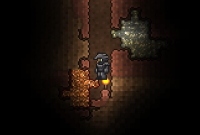
Ore alternatives are not mutually exclusive in
drunk worlds, as displayed here (Copper Ore on the left, Tin Ore on the right).
- In a drunk world(Desktop, Console and Mobile versions), both alternative ore types in each tier are available.
Non-equivalencies
While most objects made of or implied to be made of ores and their derivatives have equivalents in the same tier, there exist several exceptions:
- Copper / Tin
- The Tin Can, obtained via fishing, has no "Copper Can" counterpart.
- The Merchant will always sell Copper tools even in Tin-containing worlds.
- Newly-spawned characters and respawning Mediumcore characters will always respawn with Copper tools even in Tin-containing worlds.
- Iron / Lead
- While implied to be linked to ore progression due to the Hardmode Mythril Crate, the Iron Crate does not have a "Lead Crate" counterpart.
- The Ironskin Potion, despite its name, can be crafted using either Iron Ore or Lead Ore; there is no "Leadskin Potion" counterpart.
- The Merchant will always sell an Iron Anvil even in Lead-containing worlds.
- Underground Cabins will always spawn with an Iron Anvil even in Lead-containing worlds.
- Newly-spawned Journey Mode(Desktop, Console and Mobile versions) characters will always have Iron tools even in Lead-containing worlds.
- Gold / Platinum
- The Gold Chest does not have a "Platinum Chest" counterpart.
- Golden furniture and Gold Ring, dropped by the Pirate Invasion enemies, do not have platinum counterparts.
- Gold Dust, alongside its derivatives and related buffs and debuffs, does not have a platinum counterpart.
- Gold versions of critters do not have platinum counterparts.
- The Golden Carp does not have a "Platinum Carp" counterpart.
- While implied to be linked to ore progression due to the Hardmode Titanium Crate, the Gold Crate does not have a "Platinum Crate" counterpart.
- Despite gold and platinum being of the same tier for ores, Platinum Coins are in the tier directly above Gold Coins.
- Cobalt / Palladium
- Mythril / Orichalcum
- While implied to be linked to ore progression due to the pre-Hardmode Iron Crate, the Mythril Crate does not have an "Orichalcum Crate" counterpart.
- Adamantite / Titanium
- While implied to be linked to ore progression due to the pre-Hardmode Gold Crate, the Titanium Crate does not have an "Adamantite Crate" counterpart.
History
- Desktop 1.4.0.1: Increased the sell values of Demonite, Crimtane, and Chlorophyte.
- Desktop 1.2.3:
- Ore now stacks to 999.
- Chlorophyte is slightly rarer and grows slower.
- Hardmode ores generate slightly less.
- Desktop 1.2:
- Added 8 new ores as possible alternatives to the original 8: Tin, Lead, Tungsten, Platinum, Crimtane, Palladium, Orichalcum, and Titanium Ore, ordered by tier.
- Added Chlorophyte Ore.
- Desktop 1.0.2: Mining stone and other hard makes a "tink" sound now.
- Desktop-Release: Introduced Copper, Iron, Silver, and Gold Ores, Hellstone, Obsidian, and Meteorite.
- Console 1.06:
- Ore now stacks to 999.
- Chlorophyte is slightly rarer and grows slower.
- Hardmode ores generate slightly less.
- Console-Release: Introduced with mining noises.
- Pre-Hardmode ores: Copper, Iron, Silver, and Gold Ores, Hellstone, Obsidian, and Meteorite.
- Hardmode ores: Cobalt, Mythril, and Adamantite Ores.
- Mobile 1.2.11212:
- Ore now stacks to 999.
- Chlorophyte is slightly rarer and grows slower.
- Hardmode ores generate slightly less.
- Mobile 1.1.5536: Introduced Hardmode ores: Cobalt, Mythril and Adamantite Ore.
- Mobile-Release: Introduced Copper, Iron, Silver, and Gold Ores, Hellstone, Obsidian, and Meteorite. These make noises when mined.
- 3DS-Release: Introduced with mining noises and generation mechanics from Desktop 1.2.3.
- Pre-Hardmode ores: Copper, Tin, Iron, Lead, Silver, Tungsten, Gold, and Platinum Ores, Hellstone, Obsidian, and Meteorite.
- Hardmode ores: Cobalt, Palladium, Mythril, Orichalcum, Adamantite, Titanium, and Chlorophyte Ores.
References
- ↑ Information taken from the
 Desktop 1.4.4.9 source code, method
 GenerateWorld() in Terraria.WorldGen.cs and class UnifiedRandom in Terraria.Utilities.cs.
- ↑ Information taken from the Desktop 1.4.0.5 source code, methods
SmashAltar() in Terraria.WorldGen.cs and OreRunner() in Terraria.WorldGen.cs. There may be inaccuracies, as the current Desktop version is 1.4.4.9.
- ↑ The exact maximum height for Adamantite/Titanium can be calculated with the following formula:
( (|height of the top of the world| + |depth of the Underground/Cavern border|)*2 + total world height ) / 3. Information taken from the Desktop 1.4.0.5 source code, method SmashAltar() in Terraria.WorldGen.cs. The formula used there is Main.rockLayer + Main.rockLayer + (double)Main.maxTilesY) / 3.0. There may be inaccuracies, as the current Desktop version is 1.4.4.9.
- ↑ Information taken from the Desktop 1.4.4.9 source code, method
OreRunner() in Terraria.WorldGen.cs.
Luck(Desktop, Console and Mobile versions) - Greater Luck(Desktop, Console and Mobile versions)
- Luck(Desktop, Console and Mobile versions)
- Lesser Luck(Desktop, Console and Mobile versions)
Other
- Builder(Desktop, Console, Old-gen console and Mobile versions)
- Love(Desktop, Console, Old-gen console and Mobile versions)
- Mining(Desktop, Console, Old-gen console and Mobile versions)
- Red(Desktop, Console and Mobile versions)
- Stink
- Ale
- Apple Pie(Desktop, Console and Mobile versions)
- Bacon(Desktop, Console and Mobile versions)
- Banana Split(Desktop, Console and Mobile versions)
- BBQ Ribs(Desktop, Console and Mobile versions)
- Bowl of Soup
- Bunny Stew(Desktop, Console and Mobile versions)
- Burger(Desktop, Console and Mobile versions)
- Carton of Milk(Desktop, Console and Mobile versions)
- Chicken Nugget(Desktop, Console and Mobile versions)
- Chocolate Chip Cookie(Desktop, Console and Mobile versions)
- Christmas Pudding(Desktop, Console, Old-gen console and Mobile versions)
- Coffee(Desktop, Console and Mobile versions)
- Cooked Marshmallow
- Cream Soda(Desktop, Console and Mobile versions)
- Escargot(Desktop, Console and Mobile versions)
- Fishing foods
- Fried Egg(Desktop, Console and Mobile versions)
- Fries(Desktop, Console and Mobile versions)
- Froggle Bunwich(Desktop, Console and Mobile versions)
- Fruits(Desktop, Console and Mobile versions)
- Gingerbread Cookie(Desktop, Console, Old-gen console and Mobile versions)
- Golden Delight(Desktop, Console and Mobile versions)
- Grapes(Desktop, Console and Mobile versions)
- Grape Juice(Desktop, Console and Mobile versions)
- Grilled Squirrel(Desktop, Console and Mobile versions)
- Grub Soup(Desktop, Console and Mobile versions)
- Hotdog(Desktop, Console and Mobile versions)
- Ice Cream(Desktop, Console and Mobile versions)
- Joja Cola(Desktop, Console and Mobile versions)
- Milkshake(Desktop, Console and Mobile versions)
- Monster Lasagna(Desktop, Console and Mobile versions)
- Nachos(Desktop, Console and Mobile versions)
- Pad Thai(Desktop, Console, Old-gen console and Mobile versions)
- Pizza(Desktop, Console and Mobile versions)
- Pho(Desktop, Console, Old-gen console and Mobile versions)
- Potato Chips(Desktop, Console and Mobile versions)
- Pumpkin Pie
- Roasted Bird(Desktop, Console and Mobile versions)
- Roasted Duck(Desktop, Console and Mobile versions)
- Sake(Desktop, Console, Old-gen console and Mobile versions)
- Sauteed Frog Legs(Desktop, Console and Mobile versions)
- Shrimp Po' Boy(Desktop, Console and Mobile versions)
- Shucked Oyster(Desktop, Console and Mobile versions)
- Spaghetti(Desktop, Console and Mobile versions)
- Steak(Desktop, Console and Mobile versions)
- Sugar Cookie(Desktop, Console, Old-gen console and Mobile versions)
- Teacup(Desktop, Console and Mobile versions)
- Snowball
- Rotten Egg
- Shuriken
- Grenade
(
- Sticky(Desktop, Console, Old-gen console and Mobile versions)
- Bouncy(Desktop, Console and Mobile versions)
- Happy(Desktop, Console and Mobile versions)
)
- Beenade
- Throwing Knife
- Star Anise(Desktop, Console, Old-gen console and Mobile versions)
- Spiky Ball
- Frost Daggerfish(Desktop, Console and Mobile versions)
- Javelin(Desktop, Console and Mobile versions)
(
- Bone(Desktop, Console and Mobile versions)
)
- Bone
- Molotov Cocktail(Desktop, Console, Old-gen console and Mobile versions)
Dye(Desktop, Console, Old-gen console and Mobile versions) - Red(Desktop, Console, Old-gen console and Mobile versions)
- Orange
- Yellow
- Lime
- Green
- Teal
- Cyan(Desktop, Console, Old-gen console and Mobile versions)
- Sky Blue
- Blue
- Purple(Desktop, Console, Old-gen console and Mobile versions)
- Violet(Desktop, Console, Old-gen console and Mobile versions)
- Pink
- Black(Desktop, Console, Old-gen console and Mobile versions)
- Ancient Cloth(Desktop, Console and Mobile versions)
- Beetle Husk
- Broken Hero Sword
- Cursed Flame
- Ectoplasm
- Forbidden Fragment(Desktop, Console and Mobile versions)
- Frost Core(Desktop, Console, Old-gen console and Mobile versions)
- Light Shard
- Mechanical Pieces
(
- Battery(Desktop, Console and Mobile versions)
- Wagon(Desktop, Console and Mobile versions)
- Wheel(Desktop, Console and Mobile versions)
)
- Pixie Dust
- Spider Fang(Desktop, Console, Old-gen console and Mobile versions)
- Solar Tablet Fragment(Desktop, Console and Mobile versions)
- Spooky Wood
- Turtle Shell
- Unicorn Horn
- Solar(Desktop, Console and Mobile versions)
- Vortex(Desktop, Console and Mobile versions)
- Nebula(Desktop, Console and Mobile versions)
- Stardust(Desktop, Console and Mobile versions)
Pre-Hardmode Crates- Wooden
- Iron
- Golden
- Jungle(Desktop, Console and Mobile versions)
- Sky(Desktop, Console and Mobile versions)
- Corrupt(Desktop, Console and Mobile versions)
- Crimson(Desktop, Console and Mobile versions)
- Hallowed(Desktop, Console and Mobile versions)
- Dungeon(Desktop, Console and Mobile versions)
- Frozen(Desktop, Console and Mobile versions)
- Oasis(Desktop, Console and Mobile versions)
- Obsidian(Desktop, Console and Mobile versions)
- Ocean(Desktop, Console and Mobile versions)
Hardmode Crates- Pearlwood(Desktop, Console and Mobile versions)
- Mythril(Desktop, Console and Mobile versions)
- Titanium(Desktop, Console and Mobile versions)
- Bramble(Desktop, Console and Mobile versions)
- Azure(Desktop, Console and Mobile versions)
- Defiled(Desktop, Console and Mobile versions)
- Hematic(Desktop, Console and Mobile versions)
- Divine(Desktop, Console and Mobile versions)
- Stockade(Desktop, Console and Mobile versions)
- Boreal(Desktop, Console and Mobile versions)
- Mirage(Desktop, Console and Mobile versions)
- Hellstone(Desktop, Console and Mobile versions)
- Seaside(Desktop, Console and Mobile versions)
Permanent Power-Ups
- Life Crystal
- Life Fruit
- Mana Crystal
- Demon Heart(Desktop, Console and Mobile versions)
- Peddler's Satchel(Desktop, Console and Mobile versions)
- Advanced Combat Techniques(Desktop, Console and Mobile versions)
- Advanced Combat Techniques: Volume Two(Desktop, Console and Mobile versions)
- Minecart Upgrade Kit(Desktop, Console and Mobile versions)
- Artisan Loaf(Desktop, Console and Mobile versions)
- Torch God's Favor(Desktop, Console and Mobile versions)
- Vital Crystal(Desktop, Console and Mobile versions)
- Arcane Crystal(Desktop, Console and Mobile versions)
- Aegis Fruit(Desktop, Console and Mobile versions)
- Ambrosia(Desktop, Console and Mobile versions)
- Galaxy Pearl(Desktop, Console and Mobile versions)
- Gummy Worm(Desktop, Console and Mobile versions)
Miscellaneous
- Coins
- Defender Medal(Desktop, Console and Mobile versions)
- Bait
- Etherian Mana(Desktop, Console and Mobile versions)
- Paints(Desktop, Console, Old-gen console and Mobile versions)
- Wire
- Ropes
- Rope Coils
(
- Silk(Desktop, Console and Mobile versions)
- Vine(Desktop, Console and Mobile versions)
- Web(Desktop, Console and Mobile versions)
)
- Marshmallow on a Stick
- Glowstick
(
- Sticky
- Bouncy(Desktop, Console and Mobile versions)
- Spelunker(Desktop, Console and Mobile versions)
- Fairy(Desktop, Console and Mobile versions)
)
- Vile Powder
- Vicious Powder(Desktop, Console and Mobile versions)
- Purification Powder
- Smoke Bomb
- Sparkle Slime Balloon(Desktop, Console and Mobile versions)
- Confetti Gun
- Bunny License(Desktop, Console and Mobile versions)
(
- Cat(Desktop, Console and Mobile versions)
- Dog(Desktop, Console and Mobile versions)
)
- Chum Bucket(Desktop, Console and Mobile versions)
- Fertilizer(Desktop, Console and Mobile versions)
- Geode(Desktop, Console and Mobile versions)
- Chest Lock(Desktop, Console and Mobile versions)
- World Globe(Desktop, Console and Mobile versions)
- Tree Globe(Desktop, Console and Mobile versions)
- Moon Globe(Desktop, Console and Mobile versions)
- Gas Trap(Desktop, Console and Mobile versions)
- Glass
(
- Waterfall(Desktop, Console, Old-gen console and Mobile versions)
- Lavafall(Desktop, Console, Old-gen console and Mobile versions)
- Honeyfall(Desktop, Console and Mobile versions)
- Sandfall(Desktop, Console and Mobile versions)
- Snowfall(Desktop, Console and Mobile versions)
- Confetti(Desktop, Console, Old-gen console and Mobile versions)
- Midnight Confetti(Desktop, Console, Old-gen console and Mobile versions)
- Blue Starry(Desktop, Console and Mobile versions)
- Gold Starry(Desktop, Console and Mobile versions)
)
- Gemspark(Desktop, Console, Old-gen console and Mobile versions)
- Slime
- Fragments (Desktop, Console and Mobile versions)
(
- Vortex(Desktop, Console and Mobile versions)
- Nebula(Desktop, Console and Mobile versions)
- Stardust(Desktop, Console and Mobile versions)
- Solar(Desktop, Console and Mobile versions)
)
- Crystal(Desktop, Console and Mobile versions)
- Asphalt
- Bone
- Spider Nest(Desktop, Console and Mobile versions)
- Flesh
- Lesion(Desktop, Console and Mobile versions)
- Reef(Desktop, Console and Mobile versions)
Other
- Wood
(
- Dynasty(Desktop, Console, Old-gen console and Mobile versions)
- Spooky
)
- Red Dynasty Shingles(Desktop, Console, Old-gen console and Mobile versions)
(
- Blue(Desktop, Console, Old-gen console and Mobile versions)
)
- Anti-Portal(Desktop, Console and Mobile versions)
- Bubble(Desktop, Console and Mobile versions)
- Candy Cane
- Cog
- Coralstone
- Echo(Desktop, Console and Mobile versions)
- Martian Conduit Plating(Desktop, Console and Mobile versions)
- Pine Tree(Desktop, Console, Old-gen console and Mobile versions)
- Smoke(Desktop, Console and Mobile versions)
- Sturdy Fossil(Desktop, Console and Mobile versions)
- Team(Desktop, Console and Mobile versions)
- Silly Balloon(Desktop, Console and Mobile versions)
- Smooth Sandstone(Desktop, Console and Mobile versions)
- Smooth Marble Block(Desktop, Console and Mobile versions)
- Smooth Granite Block(Desktop, Console and Mobile versions)
- Poo(Desktop, Console and Mobile versions)
Normal
- Gray
- Stone Slab(Desktop, Console, Old-gen console and Mobile versions)
(
- Accent(Desktop, Console and Mobile versions)
)
- Red
- Mudstone
- Stucco
- Sandstone
(
- Slab(Desktop, Console, Old-gen console and Mobile versions)
)
- Snow
- Ice
- Smooth Granite(Desktop, Console and Mobile versions)
- Smooth Marble(Desktop, Console and Mobile versions)
- Iridescent
- Ebonstone
- Crimstone(Desktop, Console and Mobile versions)
- Pearlstone
- Aetherium(Desktop, Console and Mobile versions)
- Rainbow
- Dungeon
(
- Cracked(Desktop, Console and Mobile versions)
- Ancient(Desktop, Console and Mobile versions)
)
- Glowing Moss Bricks
(
- Lava(Desktop, Console and Mobile versions)
- Krypton(Desktop, Console and Mobile versions)
- Xenon(Desktop, Console and Mobile versions)
- Argon(Desktop, Console and Mobile versions)
- Neon(Desktop, Console and Mobile versions)
- Helium(Desktop, Console and Mobile versions)
)
- Lihzahrd
- Copper
(
- Plating(Desktop, Console, Old-gen console and Mobile versions)
- Ancient(Desktop, Console and Mobile versions)
)
- Tin
(
- Plating(Desktop, Console, Old-gen console and Mobile versions)
)
- Iron(Desktop, Console and Mobile versions)
- Lead(Desktop, Console and Mobile versions)
- Silver
(
- Ancient(Desktop, Console and Mobile versions)
)
- Tungsten
- Gold
(
- Ancient(Desktop, Console and Mobile versions)
)
- Platinum
- Demonite
- Crimtane(Desktop, Console and Mobile versions)
- Meteorite(Desktop, Console and Mobile versions)
- Obsidian
(
- Ancient(Desktop, Console and Mobile versions)
)
- Hellstone
(
- Ancient(Desktop, Console and Mobile versions)
)
- Dirt
(
- Cave(Desktop, Console and Mobile versions)
- Cracked(Desktop, Console and Mobile versions)
- Crumbling(Desktop, Console and Mobile versions)
- Layered(Desktop, Console and Mobile versions)
- Rocky(Desktop, Console and Mobile versions)
- Rough(Desktop, Console and Mobile versions)
- Wavy(Desktop, Console and Mobile versions)
)
- Stone
(
- Craggy(Desktop, Console and Mobile versions)
- Fractured(Desktop, Console and Mobile versions)
- Ivy(Desktop, Console and Mobile versions)
- Lichen(Desktop, Console and Mobile versions)
- Mottled(Desktop, Console and Mobile versions)
- Old(Desktop, Console and Mobile versions)
- Smouldering(Desktop, Console and Mobile versions)
- Stalactite(Desktop, Console and Mobile versions)
- Worn(Desktop, Console and Mobile versions)
- Planked
)
- Wood
- Hardened Sand(Desktop, Console and Mobile versions)
- Sandstone(Desktop, Console and Mobile versions)
- Cinder(Desktop, Console and Mobile versions)
- Ember(Desktop, Console and Mobile versions)
- Magma(Desktop, Console and Mobile versions)
- Corrupt Growth(Desktop, Console and Mobile versions)
(
- Mass(Desktop, Console and Mobile versions)
- Pustule(Desktop, Console and Mobile versions)
- Tendril(Desktop, Console and Mobile versions)
)
- Crimson Blister(Desktop, Console and Mobile versions)
(
- Crust(Desktop, Console and Mobile versions)
- Scab(Desktop, Console and Mobile versions)
- Teeth(Desktop, Console and Mobile versions)
)
- Hallowed Cavern(Desktop, Console and Mobile versions)
(
- Crystalline(Desktop, Console and Mobile versions)
- Prism(Desktop, Console and Mobile versions)
- Shard(Desktop, Console and Mobile versions)
)
- Bamboo(Desktop, Console and Mobile versions)
(
- Large(Desktop, Console and Mobile versions)
)
- Cactus
- Pumpkin
- Mushroom
- Jungle
(
- Vine(Desktop, Console and Mobile versions)
- Leafy(Desktop, Console and Mobile versions)
)
- Granite(Desktop, Console and Mobile versions)
- Marble(Desktop, Console and Mobile versions)
- Hive
- Desert Fossil(Desktop, Console and Mobile versions)
- Cloud
- Disc
- Glass
(
- Stained
- Waterfall(Desktop, Console, Old-gen console and Mobile versions)
- Lavafall(Desktop, Console, Old-gen console and Mobile versions)
- Honeyfall(Desktop, Console and Mobile versions)
- Sandfall(Desktop, Console and Mobile versions)
- Snowfall(Desktop, Console and Mobile versions)
- Confetti(Desktop, Console, Old-gen console and Mobile versions)
- Midnight Confetti(Desktop, Console, Old-gen console and Mobile versions)
- Blue Starry(Desktop, Console and Mobile versions)
- Gold Starry(Desktop, Console and Mobile versions)
)
- Gemspark(Desktop, Console, Old-gen console and Mobile versions)
(
- Offline(Desktop, Console, Old-gen console and Mobile versions)
)
- Silly Balloon(Desktop, Console and Mobile versions)
- Slime Block
- Crystal(Desktop, Console and Mobile versions)
- Bone Block
- Spider Nest(Desktop, Console and Mobile versions)
- Flesh
- Lesion(Desktop, Console and Mobile versions)
- Cog(Desktop, Console and Mobile versions)
- Aetherium(Desktop, Console and Mobile versions)
- Hay
- Reef(Desktop, Console and Mobile versions)
- Fences
- Arcane Rune(Desktop, Console, Old-gen console and Mobile versions)
- Dynasty(Desktop, Console, Old-gen console and Mobile versions)
- Flower
- Grass
- Jungle
- Sail(Desktop, Console, Old-gen console and Mobile versions)
- Wallpapers(Desktop, Console, Old-gen console and Mobile versions)
Normal
- Gray
(
- Slab(Desktop, Console, Old-gen console and Mobile versions)
)
- Red
- Mudstone
- Stucco
- Sandstone
- Snow
- Ice
- Smooth Granite(Desktop, Console and Mobile versions)
- Smooth Marble(Desktop, Console and Mobile versions)
- Iridescent
- Ebonstone
- Crimstone(Desktop, Console and Mobile versions)
- Pearlstone
- Aetherium(Desktop, Console and Mobile versions)
- Rainbow
- Dungeon
(
- Cursed(Desktop, Console and Mobile versions)
- Ancient(Desktop, Console and Mobile versions)
)
- Glowing Moss Brick Walls
(
- Lava(Desktop, Console and Mobile versions)
- Krypton(Desktop, Console and Mobile versions)
- Xenon(Desktop, Console and Mobile versions)
- Argon(Desktop, Console and Mobile versions)
- Neon(Desktop, Console and Mobile versions)
- Helium(Desktop, Console and Mobile versions)
)
- Lihzahrd
(
- Forbidden(Desktop, Console and Mobile versions)
)
- Copper
(
- Plating(Desktop, Console, Old-gen console and Mobile versions)
- Ancient(Desktop, Console and Mobile versions)
)
- Tin
(
- Plating(Desktop, Console, Old-gen console and Mobile versions)
)
- Iron(Desktop, Console and Mobile versions)
- Lead(Desktop, Console and Mobile versions)
- Silver
(
- Ancient(Desktop, Console and Mobile versions)
)
- Tungsten
- Gold
(
- Ancient(Desktop, Console and Mobile versions)
)
- Platinum
- Demonite
- Crimtane(Desktop, Console and Mobile versions)
- Meteorite(Desktop, Console and Mobile versions)
- Obsidian(Old-gen console and 3DS versions)
- Hellstone(Desktop, Console and Mobile versions)
(
- Ancient(Desktop, Console and Mobile versions)
)



.png)
.png)


.png)
.png)


.png)
.png)


.png)
.png)


.png)
.png)


.png)

.png)
.png)

.png)
.png)


.png)
.png)


.png)
.png)


.png)


.png)